

How-to
Do Electric Cars Come with a Spare Tyre? (And What to Carry Instead)
On this page

If you have switched from a petrol car to an EV and assumed the spare is in the boot, check again. The majority of new electric cars are sold without one. Here is why, what to do in a puncture situation, and what to carry instead.
Why do most EVs not have a spare tyre?
Three reasons: weight, space, and packaging. The spare wheel and jack on a typical petrol car weighs 15–20kg. On an EV, every kilogram reduces range and adds cost in battery capacity to compensate. The space under the boot floor — where a full-size or space-saver spare normally lives — is often occupied by the battery pack or an extension of the under-boot storage area. Many EV manufacturers decided that tyre repair kits, run-flat tyres, and roadside assistance cover were a better weight/cost trade-off than a spare.
How do I know if my EV has a spare?
Look in the boot: lift the floor panel and check if there is a space-saver wheel or a full spare. Also check the car handbook — it lists what is included and where it is stored. If your EV has run-flat tyres (common on BMW iX, Mercedes EQE and some IONIQ models), there is no spare because the run-flat tyre is designed to be driven on for up to 50 miles at 50mph after losing pressure.
What should I carry instead?
For most drivers: foam tyre sealant
Foam sealant (Tyreweld is the UK market leader) is injected through the valve stem and inflates the tyre while sealing the puncture from inside. It handles 80% of road punctures — nails, screws, small objects — quickly enough to get you to a tyre centre. It does not work on sidewall damage, blowouts, or large gashes.
Important: sealant damages TPMS sensors in some EVs. Check your handbook before using. Most modern kits have TPMS-safe formulations.

Holts Tyreweld 500ml Puncture Sealant
- Inflate and seal in one step
- Works through valve stem
- 500ml for standard tyres
- Trusted UK brand
- Most common puncture fix
Price on Amazon
£9.99

Holts Tyreweld SUV/4x4 Version
- Larger 600ml can for bigger tyres
- For SUVs and crossovers
- Same valve-stem injection
- TPMS compatible formula
- Wider tyre coverage
Price on Amazon
£12.49
For more coverage: sealant + electric inflator kit
A combined kit gives you sealant and a 12V electric inflator in one case. Better than a can alone because it can re-inflate a slow-leak tyre on the road and be used for tyre pressure maintenance. The RING kit is well-reviewed and compact enough to live in the EV boot permanently.
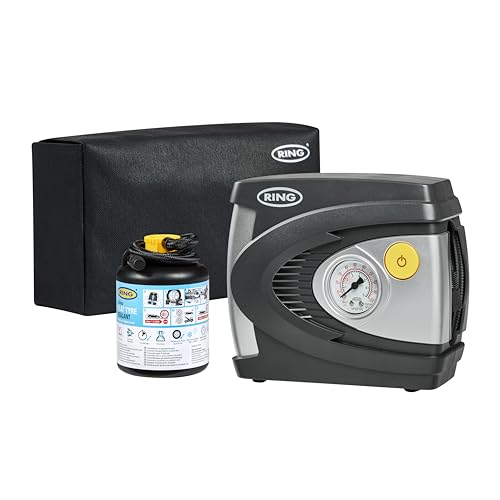
RING Flat Tyre Emergency Repair Kit
- Electric inflator + sealant
- 12V and USB-C power
- Digital tyre pressure gauge
- Compact carry case
- Works on all tyre types
Price on Amazon
£27.00
For proper puncture repair: AirMan ResQ
The AirMan ResQ is a step up from foam sealant — it uses a proper plugging compound rather than foam, has a better success rate on larger punctures, and does not contaminate the TPMS sensor. It is the kit most recovery services use for on-the-spot repairs.

AirMan ResQ Emergency Tyre Repair Kit
- Plug compound not foam
- TPMS-friendly
- Higher success rate on larger punctures
- All tyre sizes
- Professional-grade kit
Price on Amazon
£34.99
What about a proper spare tyre?
You can buy a space-saver spare wheel and jack for most EVs aftermarket. Search for your car's make and model — online EV forums often have guides for specific cars. A space-saver for a Tesla Model 3 or Hyundai IONIQ 5 typically fits under the boot floor. The cost is £150–£300 including the wheel, spare, jack, and brace. If you regularly drive on remote roads or take long trips away from motorway recovery infrastructure, it is worth considering.
Does breakdown cover compensate for no spare?
Yes — this is the practical solution most EV manufacturers point to. UK breakdown providers (AA, RAC, Green Flag) will either fix the puncture on the roadside or transport the car to a tyre centre. If you do not have European cover, add it before driving to France.

Written by
Niko MoustoukasFounder · drives a Volkswagen ID.4 & ID.5
Niko founded EV Charge Cables after going through the same faff most new EV owners hit: working out which cable actually fits which car, at what speed, and in what length, without being upsold a heavier lead than the car can ever use.
More from NikoKeep reading
More
charging guides.
Straight answers on connectors, charging speeds and what actually fits your car.
View all guides
Buying Guides
Public vs Home EV Charging: Cost and Convenience
Home charging is cheaper and more convenient for daily driving, while public charging is best kept for longer trips. Home off-peak: around 7 to 10p/kWh vs public rapid around 45 to 80p/kWh Home adds roughly 25 to 30 miles per hour; rapid DC is minutes not hours Rapid chargers are tethered; keep your own Type 2 lead for AC points

Buying Guides
Best TPMS Sensors for Electric Cars: Monitor Pressure When Parked
Tyre pressure is one of the biggest easy wins for EV range. Under-inflated tyres increase rolling resistance and reduce range by 1–3% per missing PSI. External TPMS sensors show real-time pressure on a dashboard display, including when the car is cold and parked — better than the built-in TPMS warning, which only alerts you when pressure is already critically low. Built-in TPMS warns at 25% below recommended pressure — too late for optimal range External sensors monitor continuously and alert at any deviation from your target Fits any valve stem in minutes, no coding required

How-to
Charging Your EV in France: Everything You Need to Know
Charging in France works well on the motorway (IONITY and TotalEnergies are widespread) but requires planning for overnight stops. A portable EVSE with a Schuko plug charges from any French domestic socket. For campsites, you need a Type 2 to CEE 16A adapter. Bring the standard European driving kit — it is a legal requirement. Motorway rapid charging (IONITY, TotalEnergies, Allego): same Type 2 cable as the UK Overnight at a gite or Airbnb: portable EVSE with Schuko plug, charges at 1.8–3.5kW Campsite hookup: Type 2 to CEE 16A adapter, charges at 3.6kW from a blue caravan socket

Buying Guides
Best Roof Boxes for Electric Cars: How Much Range Do You Lose?
A roof box adds aerodynamic drag that costs range on an EV more than on a petrol car. A 500L box at 70mph typically reduces range by 15–25%. The key is choosing a box with a low drag coefficient and keeping motorway speed down. For shorter runs, the range penalty is manageable. Hard shell boxes have lower drag than soft bags — choose hard shell for motorway trips Speed matters more than the box: at 60mph the penalty is roughly half what it is at 70mph Soft bags (no roof rack needed) are fine for city/slow roads where drag is minimal