

How-to
Charging Your EV in France: Everything You Need to Know
On this page

France is one of the easiest European countries to drive an EV through. The motorway rapid-charge network is good, the domestic socket standard (Schuko/French Type E) is compatible with a standard portable EVSE, and campsites almost universally have blue 16A caravan hookup sockets. Here is how to prepare properly.
Does my UK Type 2 cable work in France?
Yes. France uses the same Type 2 (Mennekes) AC charging standard as the UK. Your existing Type 2 cable works at any AC charge point in France and across the EU without modification. For rapid DC charging, CCS and CHAdeMO are also the same standards — no adapter needed.
What public charging networks should I use in France?
The three networks with the best motorway coverage are:
- IONITY — 350kW ultra-rapid at most French motorway services. Download the IONITY app before you leave.
- TotalEnergies — widespread at service stations, typically 50–150kW. Accept contactless bank cards directly.
- Allego — mainly at retail parks and urban sites, useful for overnight stays in cities.
Chargemap is the best app for France: it aggregates all networks and shows real-time availability. Download it and buy a Chargemap Pass card before you leave — it gives access to most networks without needing separate accounts.
How do I charge overnight at a French gite or Airbnb?
French domestic sockets are Type E (similar to German Schuko). A standard Type E socket delivers 230V at up to 16A — the same as a UK 13A socket in voltage terms. To charge from one, you need a portable EVSE with a Schuko plug on the mains end and a Type 2 connector on the car end.
At 16A, this gives 3.5kW — around 15–20 miles of range per hour. Plugged in overnight for 8 hours, you gain 120–160 miles. For most daily touring distances, this is enough. Check with your accommodation host first and avoid using an extension lead on the mains side.
Type 2 to Schuko adapter for French sockets
A passive Schuko adapter is the cheapest option if you already have a UK granny charger with a switchable cable end. However, for reliability and safety, a complete EVSE unit designed for Schuko use is the better buy. The AOHEWEI adapter rated 16A is a popular choice for occasional European travel.
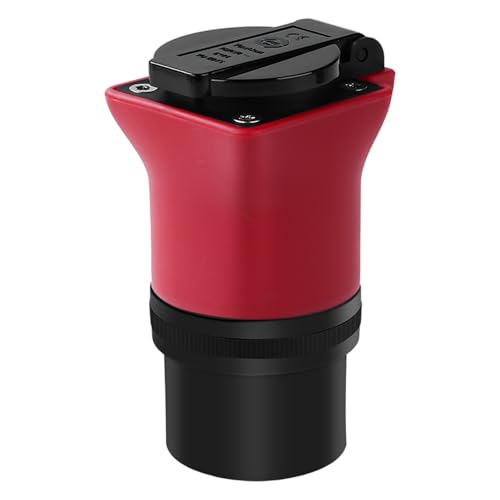
Type 2 to Schuko Charging Cable Adapter
- Type 2 to Schuko Type F
- 16A rated
- Use at French domestic sockets
- Compact and portable
- Lower cost option
Price on Amazon
£25.79
Full portable EVSE with Schuko plug
The EVDANCE unit is a complete smart EVSE with Schuko plug. It is adjustable from 6A to 16A, has temperature monitoring, and is IP65 rated — useful for outdoor sockets in French farmyards and rural gites. More expensive but more reliable than a passive adapter.

EVDANCE Type 2 to Schuko Smart EVSE
- Adjustable 6–16A
- IP65 weatherproof
- Temperature monitoring
- 6.1m cable
- 3.68kW max
Price on Amazon
£94.20
How do I charge at a French campsite?
French campsites (and most European campsites) have blue CEE 16A caravan hookup sockets on each pitch. These are the same as UK campsites. A Type 2 to CEE 16A adapter lets you plug your EV into the hookup point and charge at 3.6kW overnight.
Note that many campsites limit the time you can draw from a hookup or charge an electricity supplement. Mention to reception that you have an EV — most are accommodating and some have already seen plenty of EV guests.

AFYEEV Type 2 to CEE 16A Portable EV Charger
- Type 2 to CEE 16A (blue caravan plug)
- 7.2kW capable (16A)
- For campsite hookup charging
- Compact portable design
- Works across Europe
Price on Amazon
£107.98
Use V2L to power the campsite instead
If your car supports V2L, you can flip the equation and use the car as the power source at the campsite — running lights, a fridge, a camping kettle, or charging phones and laptops. Our V2L discharge cable with CEE output delivers up to 3.6kW from the car's battery through a standard blue campsite socket, so you can power caravan-compatible devices directly. See the full V2L guide.
What legally required items must I carry in France?
France requires all drivers (including UK visitors) to carry:
- A warning triangle
- A hi-visibility vest (accessible from inside the vehicle, not in the boot)
- Two single-use breathalyser kits (legal requirement since 2012, though not penalised if absent)
- Headlight beam deflectors (to adjust UK right-hand headlights for driving on the right — not needed on EVs with manually adjustable or adaptive headlights)
European driving kits include all of these. Buy one before you go rather than at the Eurotunnel — they are cheaper and you can pack everything properly.

EVAQ8 European Car Travel Kit
- Warning triangle
- Hi-vis vest
- 2 breathalysers
- Beam deflectors
- Meets French legal requirements
Price on Amazon
£33.95

GADLANE 2026 European Driving Kit 8 PCS
- 8 piece kit
- 2026 specification
- Warning triangle
- Hi-vis
- 2 breathalysers
- Beam deflectors
Price on Amazon
£29.99
Range planning tips for France
- Plan stops at IONITY chargers on motorways — they are reliable and fast (100–350kW depending on your car)
- The A1, A6, A7, A8, and A10 all have good IONITY coverage for the most popular UK-to-south-France routes
- In rural areas, TotalEnergies fill in the gaps — most Leclerc supermarkets have charge points
- Download Chargemap and IONITY apps before leaving. Mobile data roaming charges apply — check your plan
- If your car has a Schuko-compatible EVSE, set up overnight charges at accommodation to arrive at each motorway run with a full battery

Written by
Graham DoddCo-founder · drives a Volkswagen ID. Buzz
Graham drives a Volkswagen ID. Buzz and is happiest with it loaded up for a weekend away. Road trips, campsites and public AC points are his testing ground, so he knows first-hand why a cable needs to be the right length and easy to coil back into the boot.
More from GrahamKeep reading
More
charging guides.
Straight answers on connectors, charging speeds and what actually fits your car.
View all guides
Buying Guides
Public vs Home EV Charging: Cost and Convenience
Home charging is cheaper and more convenient for daily driving, while public charging is best kept for longer trips. Home off-peak: around 7 to 10p/kWh vs public rapid around 45 to 80p/kWh Home adds roughly 25 to 30 miles per hour; rapid DC is minutes not hours Rapid chargers are tethered; keep your own Type 2 lead for AC points

Buying Guides
Best TPMS Sensors for Electric Cars: Monitor Pressure When Parked
Tyre pressure is one of the biggest easy wins for EV range. Under-inflated tyres increase rolling resistance and reduce range by 1–3% per missing PSI. External TPMS sensors show real-time pressure on a dashboard display, including when the car is cold and parked — better than the built-in TPMS warning, which only alerts you when pressure is already critically low. Built-in TPMS warns at 25% below recommended pressure — too late for optimal range External sensors monitor continuously and alert at any deviation from your target Fits any valve stem in minutes, no coding required

How-to
Do Electric Cars Come with a Spare Tyre? (And What to Carry Instead)
Most electric cars are sold without a spare tyre. The space under the boot floor (where the spare would sit on a petrol car) is often used for the traction battery or additional storage, and the weight of a spare is avoided to improve range. Carry a tyre repair kit and inflator instead — they handle 80% of road punctures. Check your car: look in the boot floor well and the handbook — some EVs do include a space-saver spare A foam sealant kit (Holts Tyreweld) handles slow punctures and most nail/screw punctures A full repair kit (sealant + inflator) is the right kit for UK driving; some also work on the motorway

Buying Guides
Best Roof Boxes for Electric Cars: How Much Range Do You Lose?
A roof box adds aerodynamic drag that costs range on an EV more than on a petrol car. A 500L box at 70mph typically reduces range by 15–25%. The key is choosing a box with a low drag coefficient and keeping motorway speed down. For shorter runs, the range penalty is manageable. Hard shell boxes have lower drag than soft bags — choose hard shell for motorway trips Speed matters more than the box: at 60mph the penalty is roughly half what it is at 70mph Soft bags (no roof rack needed) are fine for city/slow roads where drag is minimal