

On this page

Most EV 12V sockets are limited to 120–180W, which is more than enough to run a compressor fridge continuously. A 15L Alpicool draws around 40W at equilibrium — less than a laptop charger. Hook up a 25L or 30L model and you're still well under the socket limit. And if your car supports V2L, you can power something much larger directly through the charging inlet.
What is the difference between a compressor fridge and a cool box?
A cool box (thermoelectric, also called a Peltier cooler) can only cool to about 20°C below ambient. On a warm UK summer day, that means 10°C inside — not cold enough for meat or dairy. In a heatwave in France, it stops working entirely. A compressor fridge uses the same refrigeration cycle as your kitchen fridge and holds a set temperature (typically 0–10°C for fridge, down to -20°C for freezer mode) regardless of ambient temperature. The cost difference is £30–£50, and the compressor is worth every penny.
How much power do they draw?
At equilibrium (once the contents are cold), a compressor fridge cycles on and off and draws an average of 40–60W. Initial cool-down from room temperature is higher — 80–100W for 30–60 minutes — but then settles. Over a 10-hour overnight rest, a 25L Alpicool uses around 0.5–0.6kWh. On a 77kWh EV battery, that is less than 1% of charge. Even running from the 12V socket rather than V2L, the draw is well within the socket's 150W limit.
Should I power from 12V or V2L?
For fridges up to 30L: the 12V socket works well. Plug in and forget it. For larger models (40L+) or if you want to run multiple things at once, V2L is cleaner — you get a full 3.6kW from the charging inlet, and the fridge plugs into the mains socket on the V2L cable just like a household plug. V2L also cuts out automatically at around 20% battery, so you cannot accidentally drain the traction battery. See our V2L guide and check the list of compatible cars.
Our picks
Best for most people: Alpicool 15L
Alpicool dominates the UK portable fridge market for good reason. The 15L model holds enough for a weekend away: 12 cans plus snacks, or a few days of cold drinks and dairy. It runs on 12V DC or mains AC, reaches -20°C in freezer mode, and has a digital display and app control. At around £110, it is the default recommendation for anyone who has not bought a portable fridge before.

Alpicool 15L Compressor Fridge
- 12V DC and 240V AC
- -20°C to 20°C range
- Digital temp display
- App control via Bluetooth
- Runs well from 12V socket
Price on Amazon
£110.49
Best for longer trips: Alpicool 22L
The 22L version is the sweet spot for a couple on a week-long trip, or a family for a long weekend. Still compact enough to fit in most EV boots without sacrificing the rest of the luggage space.

Alpicool 22L Compressor Fridge
- 22L capacity
- -20°C to 20°C
- Dual zone available
- 12V and 240V AC
- USB-A charging port
Price on Amazon
£132.99
Best for families: Alpicool 30L
The 30L sits at the outer limit of what a standard 12V socket handles comfortably (start-up draws up to 100W). Fine for most sockets; if yours cuts out, switch to V2L. Holds a full week's worth of cold food for two adults.
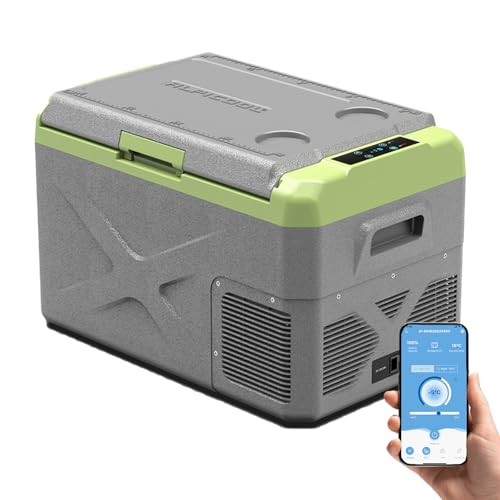
Alpicool 30L Compressor Fridge
- 30L capacity
- -20°C freezer mode
- Low noise compressor
- Works on 12V or 240V
- Locking lid
Price on Amazon
£127.49
Best budget: zcamp X20
The zcamp is a newer brand but well-reviewed. At 18.9L and under £90, it is the entry point if you want a real compressor fridge without spending Alpicool prices. Slightly louder, fewer features, but it keeps temperature reliably.

zcamp X20 Compressor Fridge
- 18.9L capacity
- 12V DC and 240V AC
- -20°C to 20°C
- Solid budget option
- Simple controls
Price on Amazon
£89.99
What size do I need?
| Trip type | People | Recommended size |
|---|---|---|
| Day trip or weekend | 1–2 | 15L |
| Long weekend, 3–4 days | 1–2 | 22L |
| Week-long trip | 2 | 25–30L |
| Family road trip | 4 | 40L+ (use V2L) |
Do I need anything else?
A good 12V extension lead (not a standard household extension — a proper 12V DC cable rated for 15A) lets you position the fridge anywhere in the boot without the cable straining. Most fridges come with a cable, but a longer spare is useful. If your car supports V2L, our V2L discharge cable plugs into the Type 2 inlet and gives the fridge a standard mains socket — the cleanest way to power anything from the car.

Written by
Niko MoustoukasFounder · drives a Volkswagen ID.4 & ID.5
Niko founded EV Charge Cables after going through the same faff most new EV owners hit: working out which cable actually fits which car, at what speed, and in what length, without being upsold a heavier lead than the car can ever use.
More from NikoKeep reading
More
charging guides.
Straight answers on connectors, charging speeds and what actually fits your car.
View all guides
Buying Guides
Public vs Home EV Charging: Cost and Convenience
Home charging is cheaper and more convenient for daily driving, while public charging is best kept for longer trips. Home off-peak: around 7 to 10p/kWh vs public rapid around 45 to 80p/kWh Home adds roughly 25 to 30 miles per hour; rapid DC is minutes not hours Rapid chargers are tethered; keep your own Type 2 lead for AC points

Buying Guides
Best TPMS Sensors for Electric Cars: Monitor Pressure When Parked
Tyre pressure is one of the biggest easy wins for EV range. Under-inflated tyres increase rolling resistance and reduce range by 1–3% per missing PSI. External TPMS sensors show real-time pressure on a dashboard display, including when the car is cold and parked — better than the built-in TPMS warning, which only alerts you when pressure is already critically low. Built-in TPMS warns at 25% below recommended pressure — too late for optimal range External sensors monitor continuously and alert at any deviation from your target Fits any valve stem in minutes, no coding required

How-to
Do Electric Cars Come with a Spare Tyre? (And What to Carry Instead)
Most electric cars are sold without a spare tyre. The space under the boot floor (where the spare would sit on a petrol car) is often used for the traction battery or additional storage, and the weight of a spare is avoided to improve range. Carry a tyre repair kit and inflator instead — they handle 80% of road punctures. Check your car: look in the boot floor well and the handbook — some EVs do include a space-saver spare A foam sealant kit (Holts Tyreweld) handles slow punctures and most nail/screw punctures A full repair kit (sealant + inflator) is the right kit for UK driving; some also work on the motorway

How-to
Charging Your EV in France: Everything You Need to Know
Charging in France works well on the motorway (IONITY and TotalEnergies are widespread) but requires planning for overnight stops. A portable EVSE with a Schuko plug charges from any French domestic socket. For campsites, you need a Type 2 to CEE 16A adapter. Bring the standard European driving kit — it is a legal requirement. Motorway rapid charging (IONITY, TotalEnergies, Allego): same Type 2 cable as the UK Overnight at a gite or Airbnb: portable EVSE with Schuko plug, charges at 1.8–3.5kW Campsite hookup: Type 2 to CEE 16A adapter, charges at 3.6kW from a blue caravan socket